
When people think about nutrients and elements important to the body, calcium, iron, magnesium, and zinc often come to mind.
Sulfur tends to receive much less attention.
Yet sulfur is a naturally occurring element that is essential to life. It is found throughout the environment, in many of the foods we eat, and in important molecules throughout the human body.
You may also have seen sulfur mentioned in connection with garlic, broccoli, hair and nails, joint health, or supplements such as MSM.
But these are not all the same thing.
Understanding what sulfur actually is—and the difference between elemental sulfur and sulfur-containing compounds—provides a useful foundation for understanding sulfur in food, the body, and dietary supplements.
What Is Sulfur?
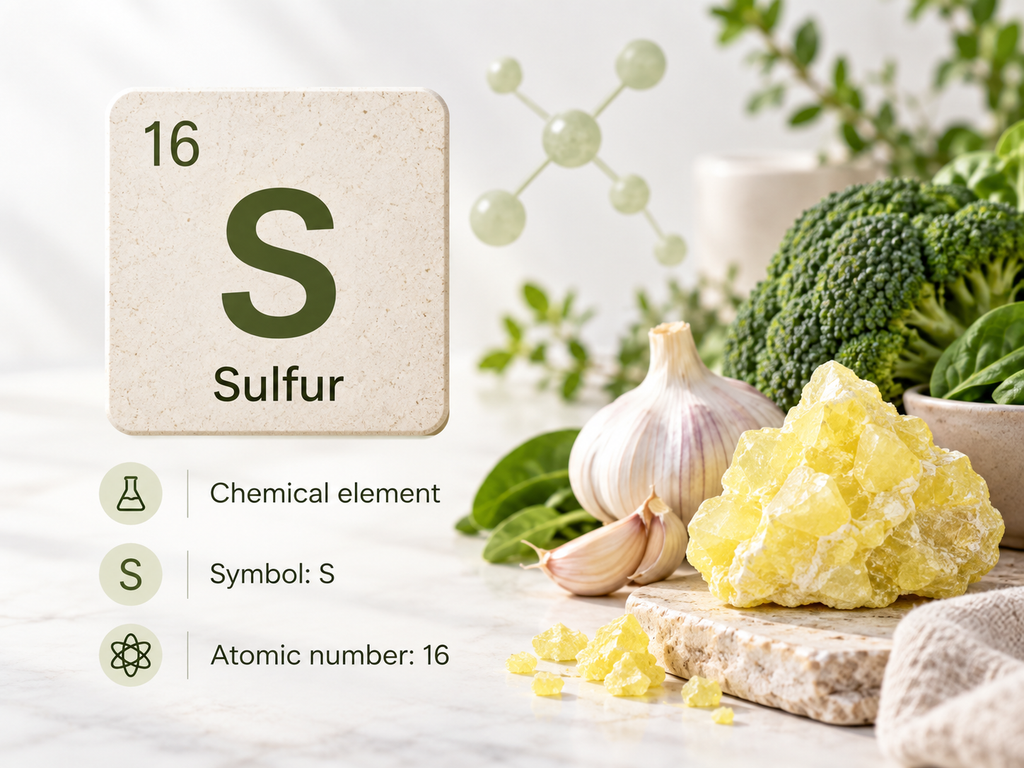
Sulfur is a chemical element represented by the symbol S and atomic number 16 on the periodic table.
It occurs naturally in rocks, soil, water, the atmosphere, and living organisms. Sulfur also moves continuously through the environment as part of the natural sulfur cycle.
In the human body, however, sulfur is usually not present as free elemental sulfur.
Instead, sulfur atoms are incorporated into larger molecules. These include certain amino acids, proteins, antioxidants, coenzymes, and other compounds involved in normal body function.
That distinction is important.
When we talk about sulfur in nutrition or human biology, we are usually talking about sulfur-containing compounds, not elemental sulfur by itself.
What Does Sulfur Do in the Body?
Sulfur does not have one single function in the body.
Its role depends on the molecule in which it is found.
For example, sulfur is present in the amino acids methionine and cysteine. These amino acids are involved in protein production and other normal metabolic processes.
Sulfur is also found in glutathione, an antioxidant that helps cells maintain normal chemical balance and manage oxidative stress.
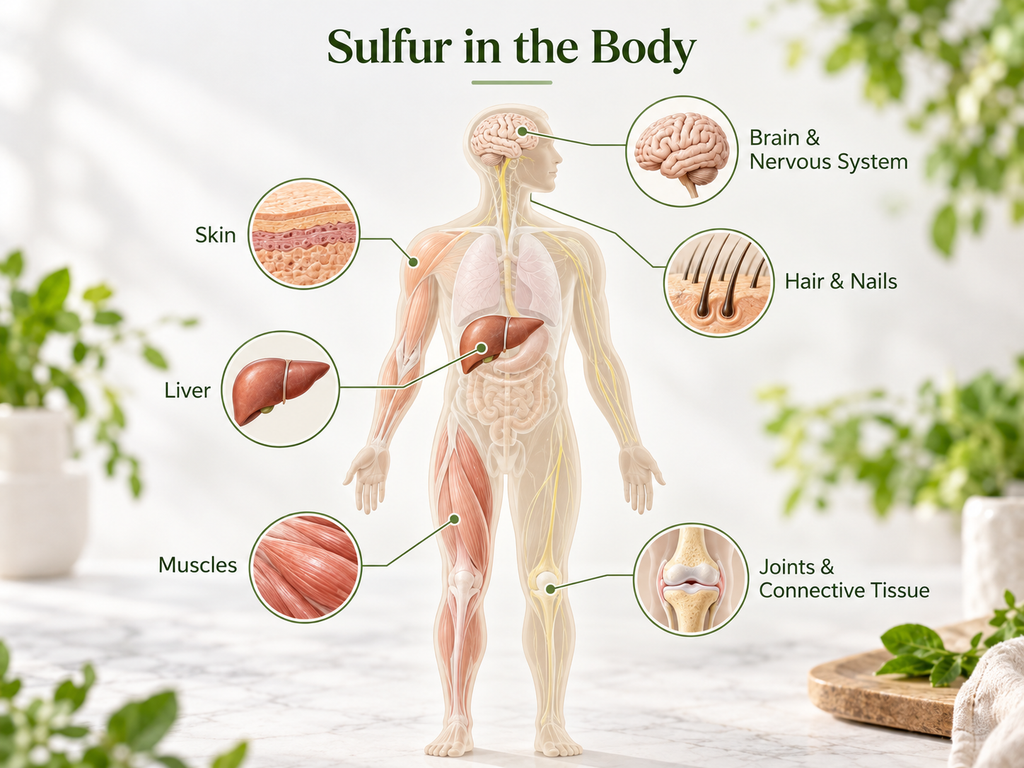
Sulfur-containing molecules can be found throughout the body, including the skin, hair, nails, cartilage, muscles, liver, brain, and nervous system.
However, sulfur does not perform exactly the same function in each location.
Sulfur in Skin, Hair, and Nails
Sulfur is often associated with hair, skin, and nails because of its presence in cysteine.
Cysteine is found in keratin, an important structural protein in skin, hair, and nails. Cysteine residues can form bonds known as disulfide bonds, which help stabilize protein structure.
This helps explain why sulfur is frequently discussed in connection with hair and nail structure.
It is important, however, not to take this biological connection too far.
The fact that sulfur is present in keratin does not automatically mean that consuming additional sulfur will make hair grow faster, improve skin, or make nails stronger.
Those types of claims need to be evaluated separately based on research involving the specific food, compound, or supplement being used.
Sulfur in Joints and Connective Tissue
Sulfur-containing compounds are also found in cartilage and other connective tissues.
Cartilage contains sulfated molecules known as glycosaminoglycans, including chondroitin sulfate and keratan sulfate. These molecules form part of the material surrounding cartilage cells and contribute to cartilage structure and properties.
Sulfur-containing amino acids are also incorporated into proteins found in tendons, ligaments, and other tissues.
Again, the presence of sulfur in connective tissue describes normal biology. It does not by itself prove that taking additional sulfur or an MSM supplement will improve joint health.
Where Does the Body Get Sulfur?
For humans, food is the main source of sulfur.
Much of the sulfur in the diet comes from the sulfur-containing amino acids methionine and cysteine, which are found in protein.
Methionine is considered an essential amino acid because it must be obtained through food. Cysteine can come directly from the diet, and under normal conditions the body can also produce it from methionine.
Both animal and plant foods can provide sulfur-containing amino acids.
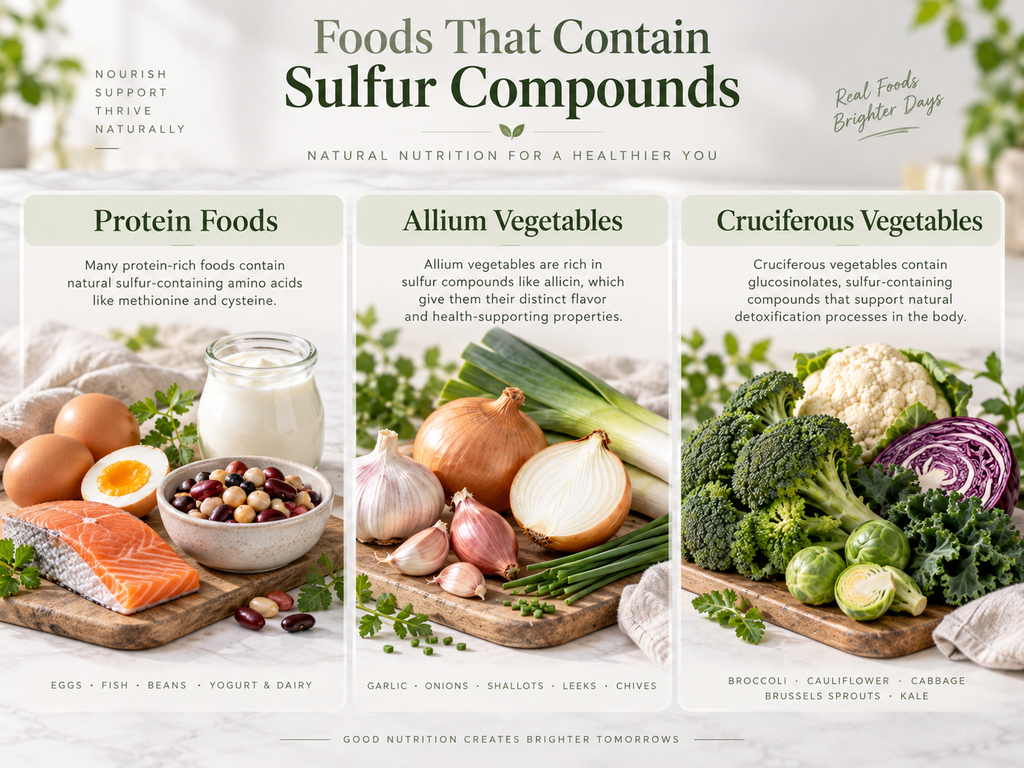
Animal sources include foods such as meat, poultry, fish, eggs, and dairy products.
Plant foods such as legumes, nuts, seeds, grains, and other protein-containing foods can also contribute methionine and cysteine.
What Foods Contain Sulfur Compounds?
Protein foods are not the only dietary sources of sulfur-containing compounds.
Some vegetables contain distinctive sulfur compounds of their own.
Garlic, onions, shallots, leeks, and chives belong to the allium family. Their characteristic flavors and aromas come partly from naturally occurring sulfur compounds.
Cruciferous vegetables such as broccoli, cauliflower, Brussels sprouts, cabbage, and kale contain sulfur-containing compounds known as glucosinolates.
When these vegetables are chopped, chewed, or cooked, glucosinolates can be broken down into a variety of other compounds.
A strong smell does not necessarily mean that a food contains more total sulfur.
Some sulfur-containing compounds can be detected by smell in very small amounts, while foods that provide sulfur-containing amino acids may have little or no noticeable sulfur-like odor.
For most people, a varied diet containing adequate protein along with a range of vegetables naturally provides several forms of dietary sulfur. There is no need to rely on one particular “sulfur superfood.”
Are All Sulfur Compounds the Same?
No.
This is one of the most important concepts to understand about sulfur.
Two substances can both contain sulfur while having very different structures and functions.
Sulfur-containing compounds include methionine, cysteine, glutathione, taurine, alpha-lipoic acid, sulforaphane, hydrogen sulfide, and methylsulfonylmethane, commonly known as MSM.
The presence of sulfur alone does not tell us how a compound behaves in the body.
For example, methionine and cysteine are amino acids involved in proteins and metabolism. Glutathione functions as an antioxidant within cells. Sulforaphane is a plant-derived compound associated with cruciferous vegetables.
Each must be understood according to its own chemistry and research.
This is why statements such as “sulfur does this” can sometimes be misleading.
The more useful question is:
Which sulfur-containing compound are we talking about?
Is Sulfur the Same as MSM?
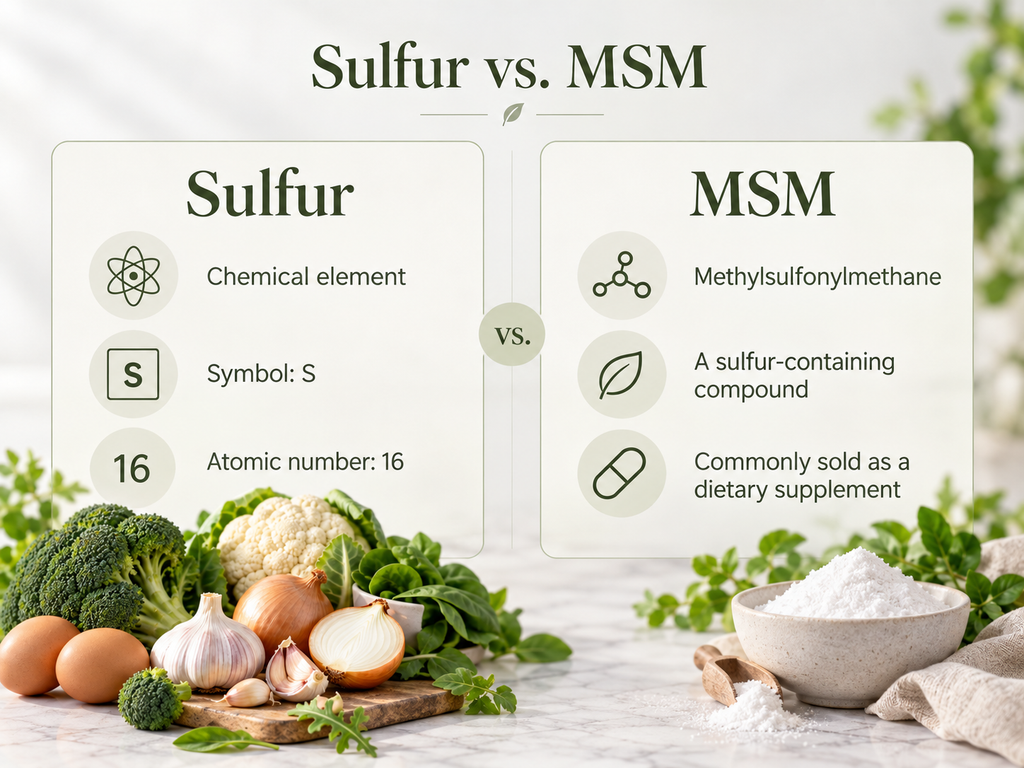
No.
Sulfur and MSM are related, but they are not the same thing.
Sulfur is a chemical element.
MSM stands for methylsulfonylmethane, also known as dimethyl sulfone. MSM is one particular compound that contains sulfur.
MSM is commonly sold as a dietary supplement and has been studied for several potential wellness applications.
However, MSM is not an amino acid, protein, or substitute for the sulfur-containing amino acids naturally obtained from food.
Research involving other sulfur compounds also cannot automatically be used to make claims about MSM.
For example, evidence involving garlic compounds, glutathione, methionine, cysteine, or sulforaphane does not necessarily tell us what MSM will do.
MSM needs to be evaluated based on studies conducted specifically on MSM.
Is Sulfur a Mineral?
Sulfur is a naturally occurring chemical element and is commonly discussed as an essential mineral element in nutrition.
Unlike some nutrients, however, people generally do not obtain sulfur by consuming elemental sulfur directly.
Most dietary sulfur comes from sulfur-containing amino acids and other naturally occurring compounds in food.
That is one reason it is helpful to distinguish between sulfur the element and the many different molecules that contain sulfur.
Can You Get Enough Sulfur From Food?
For most people eating a varied diet with adequate protein, sulfur-containing amino acids are naturally present in everyday foods.
Eggs, poultry, fish, dairy products, legumes, nuts, seeds, and grains can contribute sulfur-containing amino acids.
Garlic, onions, broccoli, cabbage, cauliflower, kale, and other vegetables provide additional sulfur-containing compounds.
Rather than focusing on one food as the “best” source of sulfur, it is more practical to include a variety of protein foods and vegetables as part of an overall balanced diet.
Sulfur vs. Sulfate vs. Sulfite vs. MSM
Sulfur-related terminology can become confusing because many compounds contain the word sulfur, sulfate, sulfite, or similar terms.
They should not be treated as interchangeable.
Sulfur is the element itself, while sulfate, sulfite, sulfur-containing amino acids, and MSM are different chemical substances.
Their names may be related because they contain sulfur, but their chemical structures and biological effects can be very different.
This becomes particularly important when reading supplement labels or health information online.
Frequently Asked Questions About Sulfur
Is sulfur naturally found in the body?
Yes. Sulfur is present as part of many naturally occurring molecules in the body, including sulfur-containing amino acids, proteins, antioxidants, and compounds found in connective tissue.
What are the main food sources of sulfur?
Much of dietary sulfur comes from protein foods that provide methionine and cysteine. Garlic, onions, cruciferous vegetables, and other plant foods also contain various sulfur compounds.
Why do garlic and onions smell like sulfur?
Garlic and onions contain sulfur-containing compounds and precursors that can produce strong-smelling substances when the plant tissue is cut, crushed, or otherwise disrupted.
Is MSM another name for sulfur?
No. MSM is a specific sulfur-containing compound. Sulfur itself is a chemical element.
Does taking more sulfur improve hair or nails?
The presence of sulfur in keratin helps explain its structural role in hair and nails, but that does not mean consuming additional sulfur will necessarily improve hair growth or nail strength. Research on a specific supplement or compound is needed before making that conclusion.
Do I need a sulfur supplement?
Sulfur-containing amino acids are naturally obtained through food. Whether a particular supplement such as MSM is appropriate is a separate question that depends on the supplement, the reason for using it, individual health considerations, and the available evidence.
The Bottom Line
Sulfur is a naturally occurring element that is found throughout the environment and within the human body.
Rather than existing mainly as free sulfur, it becomes part of many different compounds involved in protein structure, metabolism, connective tissue, antioxidant systems, and other normal biological processes.
Food is the primary way humans obtain sulfur, especially through the sulfur-containing amino acids methionine and cysteine. Garlic, onions, cruciferous vegetables, and other foods provide additional sulfur-containing compounds.
The most important point to remember is that not all forms of sulfur are the same.
Sulfur-containing amino acids, glutathione, plant compounds, sulfates, and MSM all contain sulfur, but they have different chemical structures and functions.
MSM is simply one member of this much larger family of sulfur-containing compounds, and its potential benefits and limitations need to be evaluated based on research conducted specifically on MSM.